The Science
Off-Ratio & Improper Cure Science
What happens chemically when spray foam is mixed off-ratio, how it causes shrinkage and odor complaints, and how proper application prevents it.
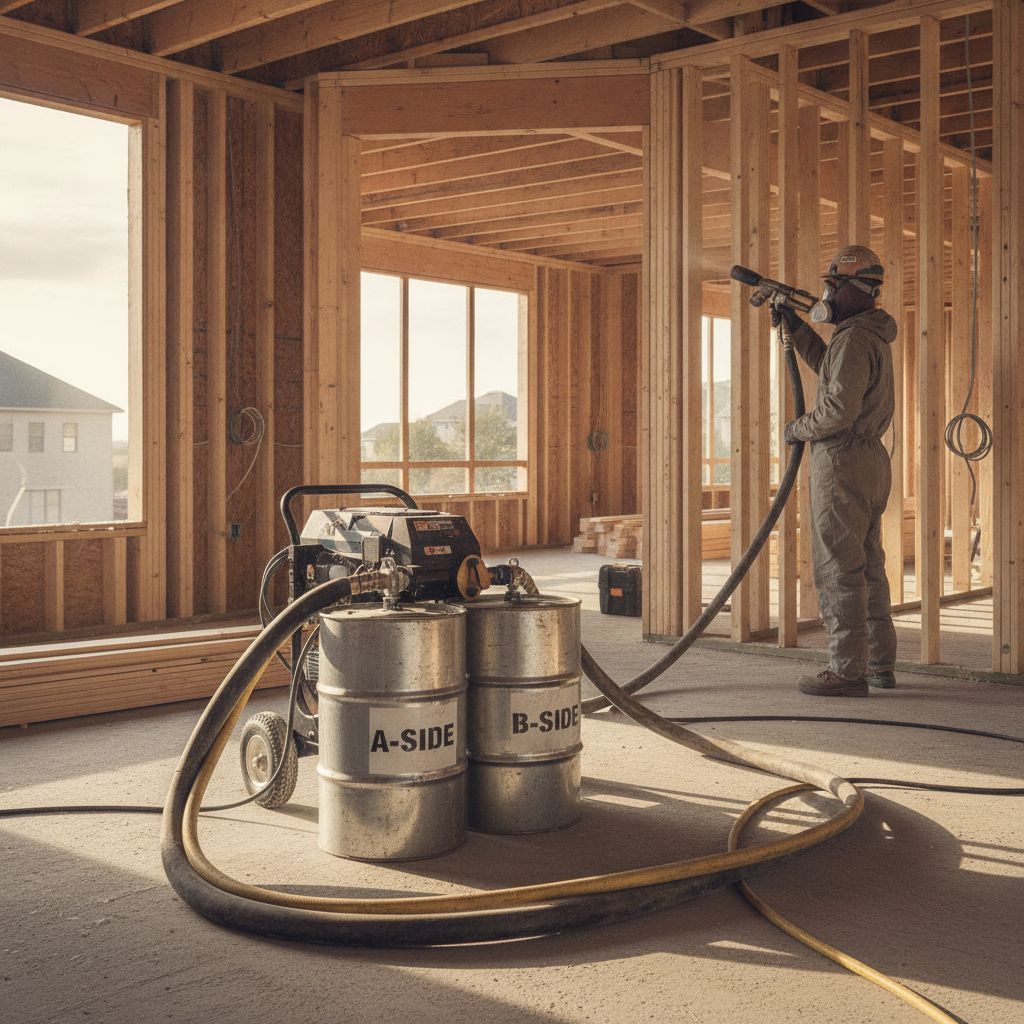
Spray polyurethane foam is a two-component chemical reaction: an “A-side” isocyanate (almost always MDI) and a “B-side” resin blend containing polyol, catalysts, surfactants, flame retardants, and the blowing agent. The reaction only produces correct, stable foam when those two components meet in close to a 1:1 ratio by volume at the spray gun. When they don't, the result is what installers call “off-ratio” foam — and it's the single most common root cause of spray foam performance complaints.
What Actually Causes an Off-Ratio Condition
The proportioner — the equipment that pumps and heats both components before they meet at the gun — has to maintain matched pressure and temperature on both the A-side and B-side lines. Miscalibration, a clogged filter on one side, mismatched heated-hose temperatures, or simply running the equipment outside its rated ambient-temperature range can all shift the actual mix ratio away from 1:1 without necessarily being obvious to an inattentive operator mid-spray.
Cold weather is a common contributing factor: both components become more viscous as temperature drops, and if the heated hoses and drum heaters aren't compensating correctly, the pump can deliver an uneven ratio even though the equipment display looks normal.
What Off-Ratio Foam Looks and Behaves Like
Foam with excess A-side (isocyanate-rich, called “A-rich”) tends to be brittle, friable, and prone to shrinkage as it cures — this is the mechanism behind foam pulling away from studs or roof decking weeks or months after installation, leaving gaps. Foam with excess B-side (resin-rich, or “B-rich”) tends to cure soft, tacky, and can retain a persistent chemical odor because the excess amine catalysts and unreacted resin components don't fully react into stable polymer.
Persistent, strong odor lasting well beyond the normal 24-72 hour off-gassing window is one of the most common homeowner complaints tied to off-ratio application, and it's a legitimate signal something went wrong in the mixing process — not something a correctly mixed, fully cured foam job should produce.
Cure Chemistry and Why Timing Matters
The reaction between isocyanate and polyol is exothermic — it generates its own heat as it cures, which is part of why manufacturers specify a maximum pass thickness (commonly around 2 inches per pass for closed-cell foam) with a cooling/waiting period between passes. Spraying too thick in a single pass traps reaction heat inside the foam core, which can cause scorching, off-gassing, or even a smoldering condition in extreme cases — a real fire-safety issue distinct from the ratio question but caused by the same category of rushed or under-trained application.
“Tack-free” time (foam no longer sticky to the touch, often 8-10 seconds after application) is not the same as full cure. EPA and manufacturer guidance on safe re-entry to a freshly sprayed space (typically 24 hours minimum, longer for sensitive individuals) reflects the time needed for the reaction to substantially complete and off-gassing to drop to a low baseline — correctly mixed foam follows this timeline reliably; off-ratio foam can extend it significantly.
Why This Is an Equipment and Training Problem, Not a Chemistry Problem
The chemistry itself is well-understood and, when executed correctly, extremely reliable — spray foam has been a standard commercial and residential insulation material for decades. Every documented off-ratio failure traces to equipment calibration, technician attentiveness, or environmental conditions the technician didn't compensate for, not to an inherent flaw in the reaction. This is why installer qualifications and equipment maintenance practices matter more to a project's outcome than which brand of foam is being sprayed.
Key Takeaways
- Off-ratio foam comes from a proportioner failing to deliver a matched 1:1 A-side/B-side ratio, not from a flaw in the chemistry itself.
- A-rich foam tends to shrink and pull away from framing; B-rich foam tends to stay soft and produce persistent odor.
- Manufacturers specify maximum pass thickness because the cure reaction is exothermic — spraying too thick in one pass risks scorching or off-gassing.
- Tack-free is not the same as fully cured — re-entry timelines exist because the reaction needs time to substantially complete.
Common Questions
Off-Ratio & Cure FAQs
Real questions people ask before starting a spray foam project.
Related Topics
Open-Cell vs. Closed-Cell Chemistry
The polyurethane chemistry that separates open-cell and closed-cell spray foam, and what it actually means for performance.
Read moreR-Value & Real-World Thermal Performance
How spray foam's R-value is measured, why lab and field numbers diverge, and what actually drives thermal performance in a real assembly.
Read moreWhy Spray Foam Becomes a “Red Flag” — The Reputation Science
The building-science reasons some spray foam jobs turn into resale, insurance, and mold problems — and why it almost always traces back to installation, not the material.
Read more
Ready to Talk to a Certified Installer?
Get matched with a vetted spray foam installer from CCA's network — free, no obligation, and grounded in the same building science you just read.