Spray Foam vs. Fiberglass: What the R-Value Numbers Actually Mean
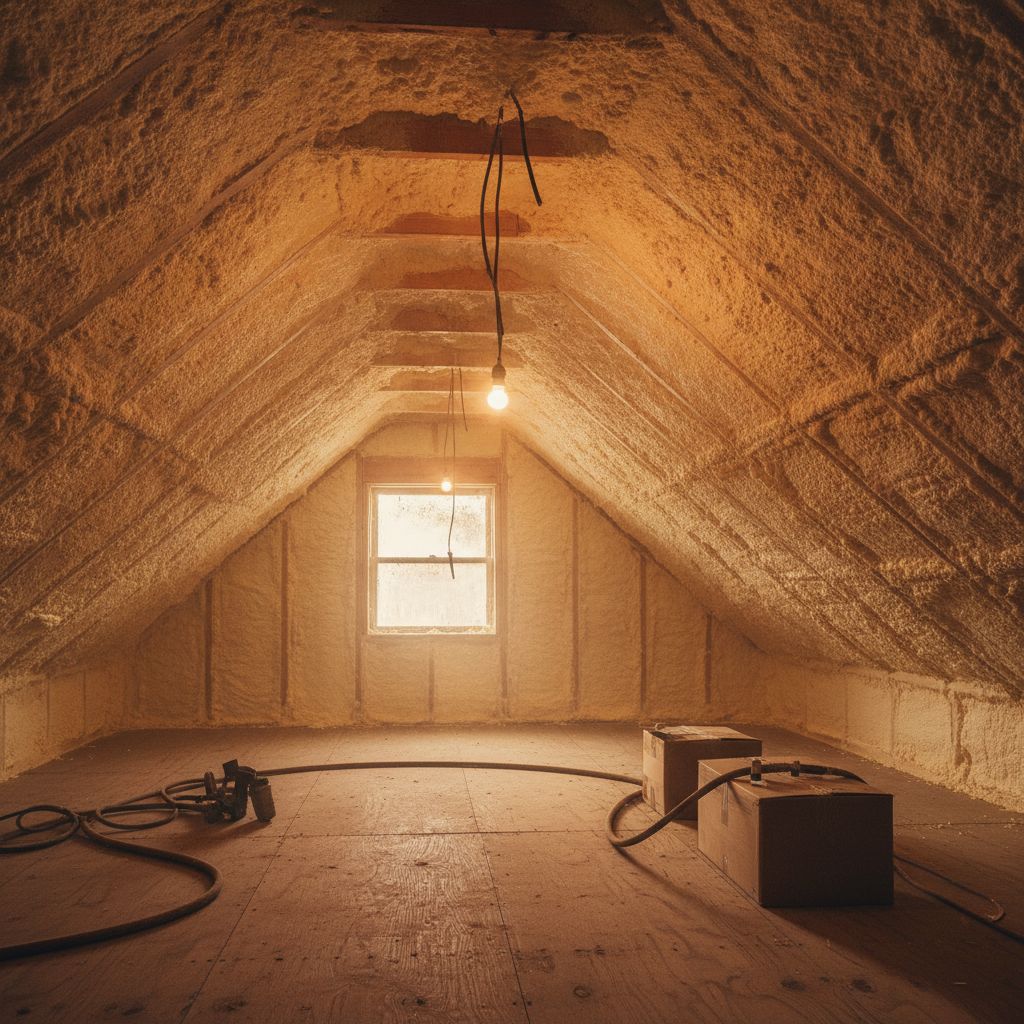
Compare spray foam and fiberglass on R-value per inch alone and fiberglass looks competitive — batt fiberglass runs roughly R-3.1 to R-3.8 per inch, not far off open-cell spray foam's R-3.5 to R-3.6. That comparison is incomplete, and it's the reason so many homeowners are surprised when a spray-foam-insulated home outperforms a same-R-value fiberglass home in practice.
The Number That Doesn't Show Up on the Spec Sheet
R-value measures resistance to conductive heat flow through a material in ideal, gap-free lab conditions. It says nothing about air leakage — and air leakage is where fiberglass batts consistently lose to spray foam in the real world. Fiberglass is a fibrous, air-permeable material that doesn't stop convective air movement through gaps, seams, or compression points. Spray foam expands to fill the cavity and adheres directly to framing, sealing those pathways as part of the same installation step.
Why Installation Quality Matters More for Fiberglass
Fiberglass batt performance is unusually sensitive to installation quality. A batt that's compressed to fit a cavity, has a gap at the top or bottom, or is cut around an electrical box without fully filling the space around it loses a disproportionate amount of its rated performance — studies have shown poorly installed fiberglass batts performing at 50-70% of their rated R-value in real assemblies. Spray foam's self-sealing expansion makes it far less sensitive to this kind of installation variance.
Where Fiberglass Still Makes Sense
None of this means fiberglass is obsolete. It costs meaningfully less per square foot, it's easier to remove or modify later (relevant for a home likely to see future renovation), and in a well-air-sealed assembly with a separate vapor-control strategy, correctly installed fiberglass can perform close to its rated value. For budget-constrained projects or additions where future access to wiring and plumbing matters, fiberglass remains a reasonable, defensible choice.
Closed-Cell Changes the Comparison Entirely
Everything above compares fiberglass to open-cell foam, which is the more common apples-to-apples
matchup on R-value per inch. Closed-cell spray foam is a different comparison altogether: at
roughly R-6 to R-7 per inch, it delivers close to double fiberglass's rated performance in the same
cavity depth, plus the air-sealing and (at sufficient thickness) vapor-control properties fiberglass
doesn't have at all. That's why closed-cell is the default choice in tight cavities — like a 2x4
rim joist or a low-slope roof deck — where there isn't room to hit code-minimum R-value with
fiberglass regardless of installation quality.
What Climate Zone Changes About the Decision
In colder climate zones, where code-minimum R-values climb and air-sealing failures show up as
visible ice damming or frozen pipes, the real-world gap between fiberglass and spray foam widens —
poor air-sealing is a bigger, more visible problem the colder the climate gets. In milder climate
zones, where the code-minimum bar is lower and air-sealing failures are less dramatic, the cost
premium for spray foam has to be weighed more carefully against a fiberglass-plus-separate-air-
sealing approach, which can close a meaningful part of the performance gap at a lower total cost.
The Honest Comparison
The fair comparison isn't R-value per inch — it's total assembly performance, including air sealing, moisture management, and installation-quality risk. Spray foam generally wins that comparison for whole-house performance and long-term reliability; fiberglass wins on upfront cost and future accessibility. Neither claim holds up if you only look at the R-value number on the bag or the spec sheet.
See our full R-Value & Thermal Performance guide for the underlying building science, or find a certified installer to get a project-specific comparison for your home.